
September 7, 2026
I Treated a Yeast Infection and It Didn't Work. What Now?
If you treated a yeast infection and your symptoms are still there, the most likely explanation is that it wasn't a yeast infection.
Studies of women buying over-the-counter antifungals have found that only about a third actually have one. The rest have bacterial vaginosis, a skin condition, hormonal thinning, or nerve pain, and none of those respond to an antifungal. In rarer cases, its a different type of yeast or a severe yeast infection that is not treated with over the counter drugs.
That's the short answer. Here's how to figure out which one you're dealing with.
Why self-diagnosis fails so often
Itching, burning, and irritation are the vagina and vulva's entire vocabulary. Almost every condition down there produces some combination of those three, which means the symptom tells you almost nothing about the cause. The thick white discharge people treat as the signature of yeast shows up in maybe half of confirmed cases, and shows up plenty of times without yeast.
Add to that: pharmacy shelves put antifungals at eye level, and there's no equivalent aisle for "get a swab." On top of that, it can be expensive and requires waiting. This explains why the default move for any vaginal symptom becomes an antifungal, and the failure rate follows.
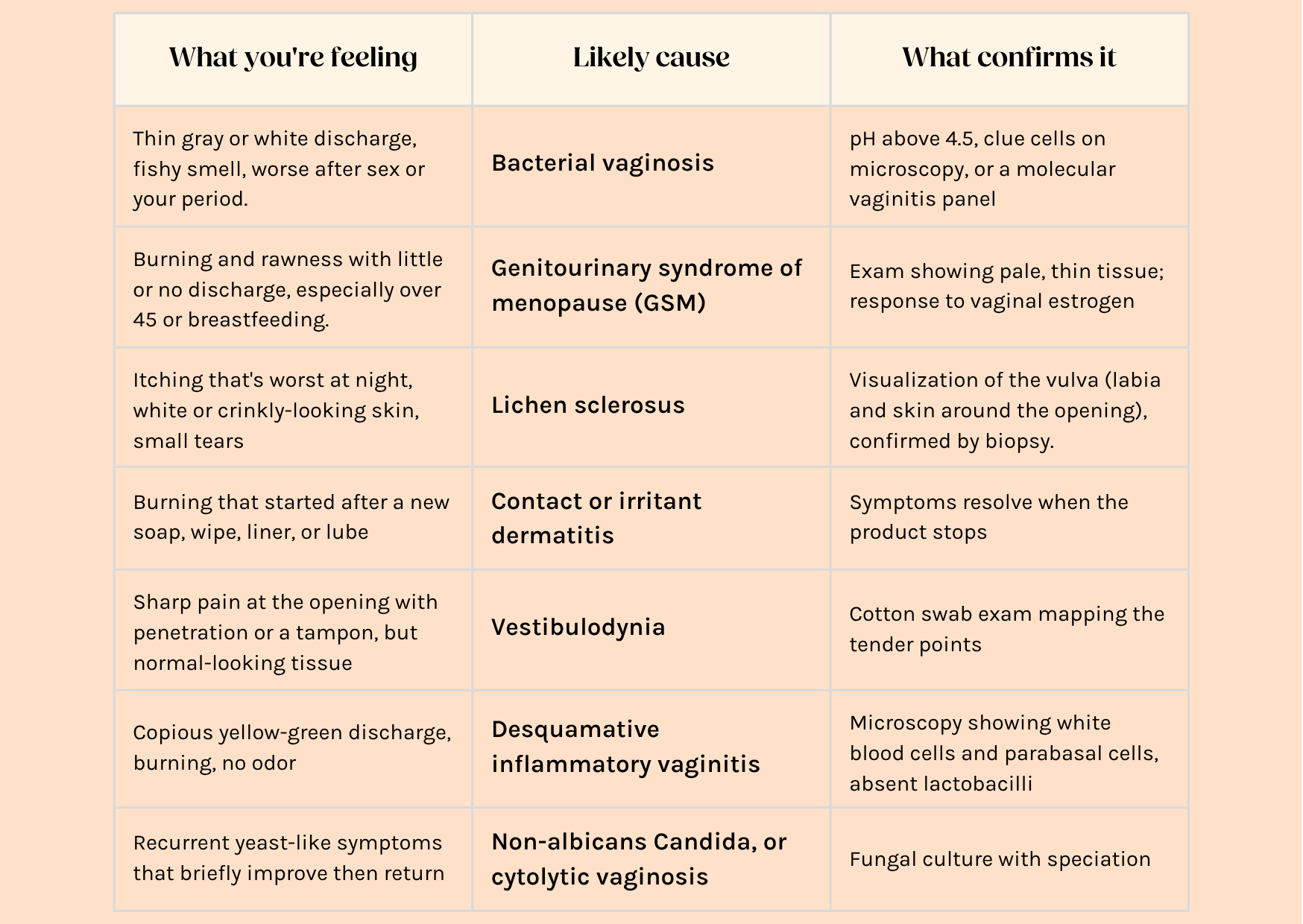
What it usually turns out to be
If you find yourself in more than one row, that's normal. These overlap, and more than one can be true at once.
Subscribe to our free newsletter, The Clit Club, to receive our best tips on menopause, perimenopause and women's health — straight to your inbox:
When it really is yeast and the treatment still failed
Three scenarios worth knowing about.
The species is wrong for the drug. Candida albicans responds well to fluconazole and to the standard over-the-counter creams. Candida glabrata often doesn't. It's a smaller share of cases, but it's overrepresented among women with repeated treatment failures, and it needs a different approach. The CDC's guidance for non-albicans species is 7 to 14 days of a non-fluconazole azole, and if it comes back, boric acid 600 mg vaginally daily for three weeks. A regular yeast test won't tell you the species. You need a fungal culture with speciation, and you have to ask for it by name.
The dose was too small for the problem. A single 150 mg fluconazole tablet is designed for an uncomplicated infection. If yours is severe, or you have diabetes, or you're immunosuppressed, one dose often isn't enough. The CDC calls for either 7 to 14 days of topical azole or two doses of fluconazole 72 hours apart.
It's genuinely recurrent, and nobody has treated it as such. Four or more culture-confirmed episodes in a year is recurrent vulvovaginal candidiasis, and it's a different disease from a one-off infection. Treating each episode as it arrives will never get you ahead of it. Real treatment means induction followed by maintenance: weekly fluconazole (100, 150, or 200 mg) for six months is the standard CDC-backed regimen.
There are also two newer prescription options. Ibrexafungerp (Brexafemme) works through a different mechanism than the azoles, which matters if azoles have failed you. Oteseconazole (Vivjoa) is approved specifically for recurrent VVC, but only in women who cannot become pregnant, which in practice means age 47 or older or permanently sterilized. Ask whether either fits your situation.
What to actually ask for at your appointment
Go in with specifics. "I keep getting yeast infections" gets you another fluconazole prescription. If you've already been treated three or four times without a culture, say that out loud. It changes the workup. Be ready with your prior medications, labs, and timeline. Sometimes expect that it will take a few treatments to improve all the symptoms if it is a combination of causes.
Come see us at Gliss Wellness, where we can take a thorough look at the history of symptoms as well as the treatments that did and did not work. We can order labs if needed and help you understand the prior tests and treatments. Book a free 15-min consult here.
Stop treating in the dark
Every round of empiric antifungal treatment does two things. It delays the real diagnosis, and it irritates already inflamed tissue. Some of the burning women describe after a third or fourth course of treatment is coming from the treatment.
If two courses haven't worked, the answer isn't a third. It's a visit and potential testing.
When to be seen sooner rather than later
Get evaluated promptly if you have pelvic or abdominal pain, fever, bleeding that isn't your period, sores or ulcers, symptoms after a new partner, or skin that's changing color or texture. Those move you past the self-treatment conversation entirely.
Common questions
Can you have a yeast infection with no discharge?
Yes. Burning and itching with minimal discharge is common, particularly in women over 45, where the same picture is more often genitourinary syndrome of menopause than yeast.
How long should a yeast infection take to clear?
With appropriate treatment, most women notice real improvement within three days and are clear within seven. Symptoms that are unchanged at one week mean the diagnosis or the drug is wrong.
Can antifungal cream make things worse?
It can. The azole creams and their preservatives cause contact dermatitis in some women, so the burning intensifies rather than settles. If your symptoms got worse rather than better after starting a cream, that's diagnostically useful information.
Does my partner need treatment?
For yeast, usually not. Routine partner treatment isn't recommended for vulvovaginal candidiasis. Bacterial vaginosis is a different story, and the evidence there changed in 2025.
Are probiotics or boric acid worth trying?
Boric acid has a defined role, mainly in non-albicans yeast and in recurrent BV protocols, at 600 mg vaginally. It's not a general-purpose fix, it's toxic if swallowed, and it isn't something to start without knowing what you're treating. The probiotic evidence is thinner than the marketing suggests.

Want to Talk Through What You're Experiencing?
Book a free 15-minute intro call with Gliss Wellness — no referral, no waiting room, just a real conversation with an OB/GYN. Click here to get started.
Sources
- CDC, Sexually Transmitted Infections Treatment Guidelines: Vulvovaginal Candidiasis. https://www.cdc.gov/std/treatment-guidelines/candidiasis.htm
- CDC, STI Treatment Guidelines: Bacterial Vaginosis. https://www.cdc.gov/std/treatment-guidelines/bv.htm
- Oteseconazole (VIVJOA) National Drug Monograph, VA Pharmacy Benefits Management, August 2023. https://www.va.gov/formularyadvisor/DOC_PDF/MON_Oteseconazole_VIVJOA_Monograph_Aug_2023.pdf
- "New Antifungals for Vulvovaginal Candidiasis: What Is Their Role?" Clinical Infectious Diseases. https://academic.oup.com/cid/article/76/5/783/6970437
- Ferris DG et al., "Over-the-counter antifungal drug misuse associated with patient-diagnosed vulvovaginal candidiasis," Obstetrics & Gynecology, 2002. https://pubmed.ncbi.nlm.nih.gov/11864668/



Real Talk, No Filter
Join our newsletter, where we talk about perimenopause, hormones, sexual health, and everything else!