
September 7, 2026
Bacterial Vaginosis Keeps Coming Back? This Is What Actually Works
If your bacterial vaginosis comes back within weeks of finishing metronidazole, you're experiencing the expected outcome, not a personal failure.
Roughly half of treated women relapse within six to twelve months. A seven-day antibiotic course clears the overgrowth but doesn't rebuild the lactobacillus population or address reinfection, so the same conditions reassemble.
Recurrent BV needs a different plan from a single episode. Here's what that plan looks like.
Why a single course of antibiotics doesn't hold
Three things are working against you:
Metronidazole kills the anaerobic bacteria that define BV, but it doesn't restore what should be there instead. A healthy vaginal environment is dominated by lactobacilli that keep pH low. Antibiotics leave a vacancy, and whichever organisms recolonize first win. Often it's the same ones.
BV organisms also form a biofilm on the vaginal wall, a structured layer that antibiotics penetrate poorly. Surviving cells inside it repopulate once the drug is gone. This is the main reason symptoms return in a predictable rhythm, often right after a period or after sex.
And then there's reinfection. For years the assumption was that BV wasn't sexually transmitted, so partners were left alone. That assumption looks wrong now. It should be noted that STDs have until now a bad connotation. It is likely that the male partner has certain skin flora outside of his control that change your flora. For this reason, I think we should call them “related to sex and certain partners”, as “sexually transmitted” implies blame on the patient.
The 2025 finding that changed partner treatment
In March 2025, the New England Journal of Medicine published the StepUp trial: an open-label randomized trial in monogamous couples where the woman had BV. One group got standard treatment for the woman only. The other group also treated the male partner with oral metronidazole 400 mg tablets plus 2% clindamycin cream applied to penile skin, both twice daily for seven days.
Recurrence at 12 weeks was 35% in the partner-treatment group versus 63% with standard care. The data safety monitoring board stopped the trial early because the difference was clear enough that continuing would have been unfair to the control group.
Two things can be true at once: that result is strong and it points toward BV being sexually transmitted in a meaningful sense; at the same time, the CDC's published guidelines still say routine partner treatment isn't recommended, because guidelines lag trials. Some health departments have already issued interim guidance.
If you have a regular male partner and recurrent BV, this is a specific, evidence-backed conversation to have with your clinician, not something to wait for the guidelines to catch up on.
The evidence for female partner treatment is much thinner. Concordance between female partners is well documented, but there's no equivalent trial.
What suppressive therapy actually involves
For repeated recurrences, the CDC describes two approaches, and they're more involved than most women are offered.
The simpler one is metronidazole gel 0.75% or a 750 mg metronidazole vaginal suppository, twice weekly for more than three months.
The more intensive one runs in three phases: an oral metronidazole first, then intravaginal boric acid 600 mg daily for 21 days, then suppressive metronidazole gel twice weekly for four to six months. The boric acid phase exists specifically to disrupt biofilm, which is why it sits between the induction and maintenance phases rather than replacing either.
Neither of these is a prescription you get in a fifteen-minute visit by asking for "something for BV." You have to name the problem as recurrent.
Having recurrent BV? Come see us at Gliss Wellness! Click here for a 15-min free intro consult.
Before you commit to months of antibiotics, confirm it's BV
Recurrent symptoms that were never actually tested are common, and several conditions produce a similar pattern of discharge and irritation that antibiotics won't touch.
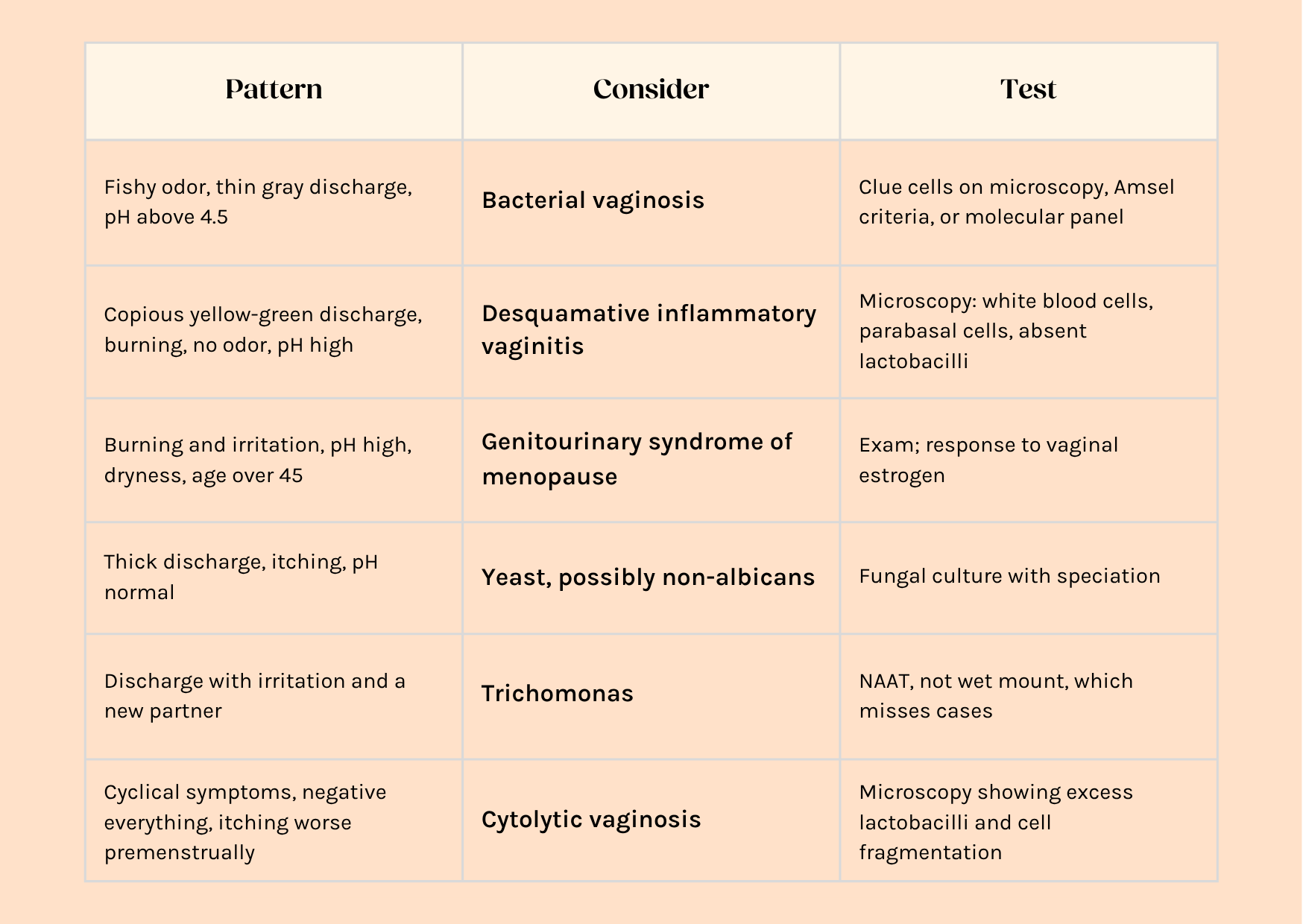
Ask specifically whether your BV was ever confirmed with microscopy or a molecular panel, or whether it was diagnosed on symptoms alone. If it's the latter, and antibiotics keep failing, that's your first thread to pull.
Subscribe to our free newsletter, The Clit Club, to receive our best tips on menopause, perimenopause and women's health — straight to your inbox:
Things that get recommended and what the evidence says
Boric acid. Real role, defined dose (600 mg vaginally), best supported as part of a recurrence protocol rather than as a standalone treatment. Toxic if swallowed. Not for use in pregnancy.
Oral probiotics. The marketing has outrun the evidence. Some Lactobacillus strains have data suggesting benefit as an adjunct, but the trials are small and inconsistent, and most retail products haven't been studied at all. Not a substitute for treatment.
Vaginal probiotics and live biotherapeutics. More promising in principle, since colonization is the actual goal, and there's active research here. Ask what specifically has been tested rather than assuming a product on a shelf reflects it.
Douching and "cleansing" washes. These make recurrence more likely. Stop. The vagina is a rainforest. Let it do its job, naturally.
Condoms. Consistent use reduces recurrence, which fits the sexual-transmission picture.
What to bring to your appointment
- Say the word "recurrent", and give the number of episodes and the dates if you have them.
- Ask whether the diagnosis was ever confirmed on microscopy.
- Ask about suppressive therapy specifically if you fit the clinical picture.
- Ask about partner treatment and mention the 2025 NEJM trial if your clinician hasn't seen it.
- And ask to be swabbed while symptomatic.
If you've had three or more episodes in a year and nobody has offered you anything beyond another seven days of metronidazole, you're being undertreated.
Common questions
How many BV recurrences is too many?
Three or more episodes in a year is generally where recurrent BV gets managed differently. Many women well past that threshold are still getting single courses.
Can BV go away without antibiotics?
Sometimes, yes. But untreated BV is associated with higher risk of acquiring sexually transmitted infections and, in pregnancy, with preterm birth, so waiting it out isn't neutral.
Does BV mean my partner cheated?
No. BV is associated with sexual activity and with new partners, but it isn't a classic STI in the way chlamydia is, and it occurs in women who haven't had a new partner. The 2025 partner-treatment data complicates the story without turning it into an infidelity test.
Why does BV come back right after my period?
Blood raises vaginal pH, which favors the anaerobic organisms and suppresses lactobacilli. Cyclical, post-menstrual recurrence is a recognized pattern.
Can I get BV from oral sex or a sex toy?
Both have been associated with BV. Toys shared between partners without cleaning are a plausible route of transfer.

Want to Talk Through What You're Experiencing?
Book a free 15-minute intro call with Gliss Wellness — no referral, no waiting room, just a real conversation with an OB/GYN. Click here to get started.
Sources
- Vodstrcil LA et al., "Male-Partner Treatment to Prevent Recurrence of Bacterial Vaginosis," New England Journal of Medicine, March 2025. https://www.nejm.org/doi/abs/10.1056/NEJMoa2405404 (PubMed: https://pubmed.ncbi.nlm.nih.gov/40043236/)
- CDC, STI Treatment Guidelines: Bacterial Vaginosis. https://www.cdc.gov/std/treatment-guidelines/bv.htm
- New York State Clinical Guidelines Program, "Partner Treatment to Prevent Recurrent Bacterial Vaginosis." https://www.hivguidelines.org/guideline/sti-bv/
- "Male partner treatment and the potential sexual transmission of bacterial vaginosis: considerations for patient counseling and clinical application in the United States," American Journal of Obstetrics & Gynecology, 2025. https://www.ajog.org/article/S0002-9378(25)00822-1/abstract
- "Advances in treating bacterial vaginosis: recognizing sexual transmission and pipeline of therapies," PMC. https://pmc.ncbi.nlm.nih.gov/articles/PMC12839515/



Real Talk, No Filter
Join our newsletter, where we talk about perimenopause, hormones, sexual health, and everything else!