
October 5, 2026
Desquamative Inflammatory Vaginitis: The Burning Nobody Diagnoses
Desquamative inflammatory vaginitis is chronic inflammation that makes the vaginal lining shed. It produces heavy yellow or green discharge, burning, and pain with sex, usually without odor, and every standard infection test comes back negative. It's diagnosed by looking at vaginal fluid under a microscope, and it responds to vaginal clindamycin or steroid, not to antifungals or the antibiotics used for bacterial vaginosis.
If you've been treated four times for infections you apparently don't have, this is a condition to ask about by name.
Why it goes unrecognized
DIV doesn't fit the pattern clinicians are trained to look for. The discharge is dramatic, so an infection seems obvious. But the swab is negative, and once yeast, BV, and trichomonas are excluded, many workups simply end. There's no reflex to go further.
Diagnosing it requires wet mount microscopy: putting a sample of vaginal fluid on a slide and looking at it. That used to be routine in gynecology offices and largely isn't anymore. Most vaginitis testing is now sent to a lab as a molecular panel, which is excellent at finding organisms and blind to inflammation. DIV is defined by inflammation. A panel that tests only for organisms will call a DIV sample normal every time.
So the condition is real, it's describable, and the test that finds it is the one that stopped being performed.
What it feels like
The discharge is the loudest symptom: copious, yellow to green, sometimes tinged with blood, and usually without the fishy odor that points to BV. Alongside it, burning and rawness at the vaginal opening, irritation and soreness, and pain with sex that can persist afterward. Some women describe a sensation of constant wetness that no amount of washing addresses.
We do caution patients that some women just make a lot of discharge. The treatment for DIV can be long with both steroids and antibiotics, and you do not want to be on this unless necessary. The defining piece here is inflammation not just lots of discharge alone.
It occurs at any age, though it's described most often in perimenopausal and postmenopausal women. Symptoms tend to be persistent rather than cyclical, which distinguishes them from the pattern many women with recurrent BV describe. Oftentimes patients states it is weeks and weeks of discharge, not it comes and goes after treatment.
How it's actually diagnosed
Four findings together make the diagnosis.
Elevated vaginal pH, generally above 4.5. Visible inflammation on exam, with redness of the vaginal walls and sometimes patchy areas or small red spots. On microscopy, a large number of white blood cells, and parabasal cells, which are immature cells from deeper in the vaginal lining that only appear when the surface is shedding. And absent or markedly reduced lactobacilli.
The parabasal cells are the specific finding. They're what "desquamative" refers to, and they're why this needs a microscope rather than a lab panel.
Ask for a wet mount. If your clinician's office doesn't do microscopy, ask for a referral to one that does, or to a vulvovaginal specialist. That single request is usually the difference between a diagnosis and another year of empiric treatment.
What it isn't
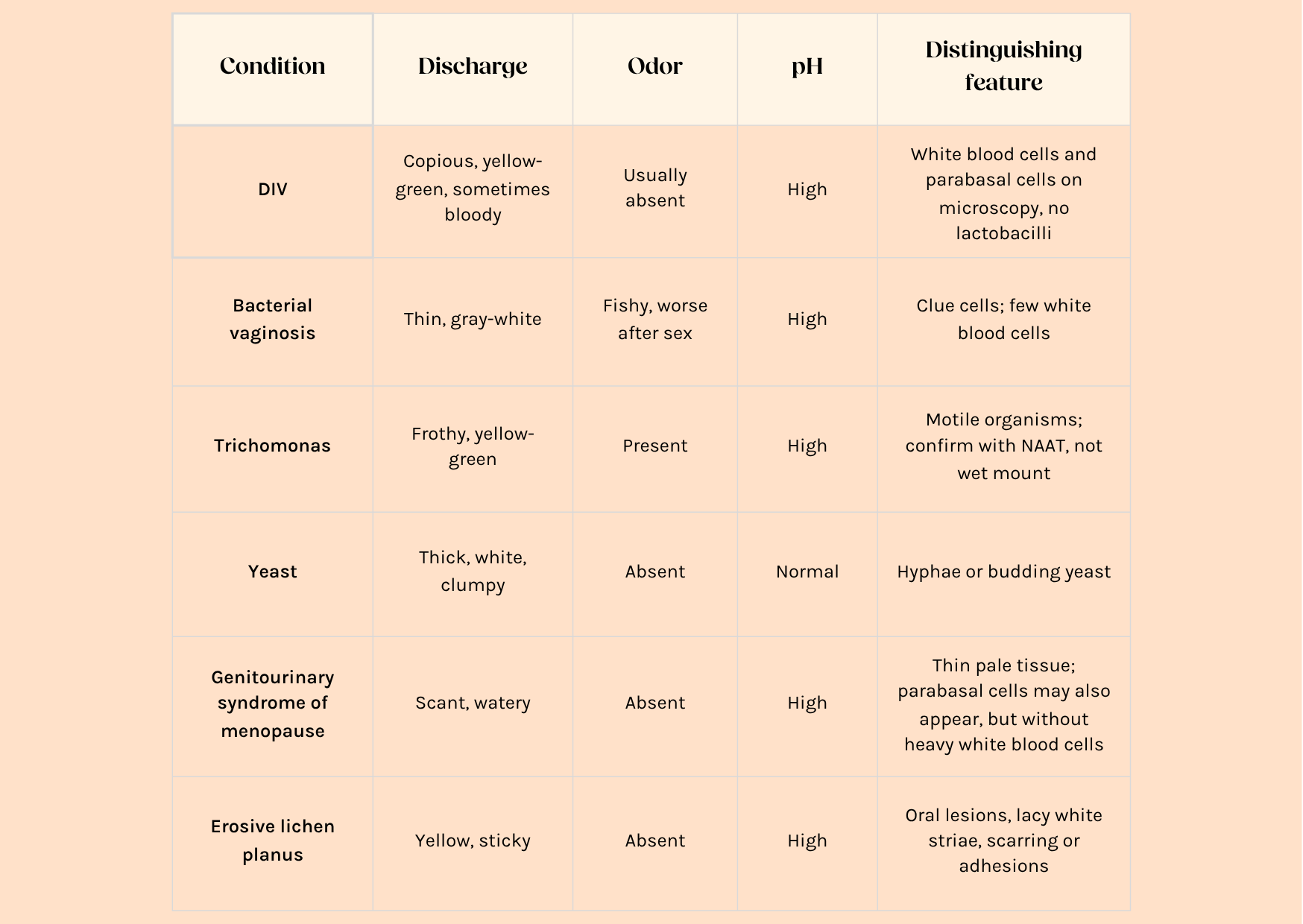
The overlap with trichomonas is the one that catches people out, since both can produce yellow-green discharge. And the overlap with erosive lichen planus matters clinically, because that one is managed differently and can scar. Both are reasons that a video visit or in person exam may be necessary for visibility.
Treatment
Two regimens, used alone or together.
Vaginal clindamycin, applied nightly for at least two weeks and then tapered to a lower frequency, is the antibacterial arm. Its role in DIV is partly anti-inflammatory rather than purely antimicrobial.
Vaginal hydrocortisone, typically 25 mg suppositories, sometimes at higher strengths from a compounding pharmacy, is the anti-inflammatory arm.
For women who are postmenopausal or otherwise estrogen-deficient, adding vaginal estrogen is often part of the plan, since the atrophic tissue contributes to the inflammation.
Response is monitored by repeat microscopy, not by symptoms alone, because the two don't always move together. Duration is set by that follow-up.
What to expect over time
Be prepared for this to be a managed condition rather than a cured one. Roughly a third of patients improve and stay well. A third improve and relapse. A third need ongoing maintenance therapy. That's the honest picture from clinicians who see a lot of it.
Knowing that in advance changes the experience. A relapse after treatment isn't a sign the diagnosis was wrong; it's one of the expected paths.
What to say at your appointment
"I've had persistent yellow-green discharge and burning. My infection tests keep coming back negative. Can we do a wet mount and check my pH? I want to rule out desquamative inflammatory vaginitis and erosive lichen planus."
That sentence gets you further than any description of symptoms, because it names the test.
Common questions
Is DIV an infection?
No. It's inflammation with disrupted vaginal flora. That's why antibiotics aimed at bacterial vaginosis and antifungals aimed at yeast don't resolve it, and why treatment includes a steroid.
Is DIV contagious?
No. It isn't sexually transmitted and partners don't need treatment.
Can DIV be mistaken for menopause?
It can, and they can coexist. Both raise vaginal pH and both can show parabasal cells. The heavy white blood cell count and the volume of discharge point toward DIV. This is a distinction that needs a microscope, not a symptom checklist.
How long does treatment take?
Initial treatment usually runs at least a few weeks, followed by a taper, with repeat microscopy guiding the timeline. Many women need maintenance therapy afterward.
Does DIV affect fertility?
There's no established link between DIV and infertility. The pain with sex it causes is the more direct obstacle for women trying to conceive.
Why has no doctor mentioned this to me?
Because the diagnosis depends on in-office microscopy, which has largely disappeared from general gynecology practice. It isn't obscure among vulvovaginal specialists. It's invisible to a workflow built around send-out panels.

Want to Talk Through What You're Experiencing?
Book a free 15-minute intro call with Gliss Wellness — no referral, no waiting room, just a real conversation with an OB/GYN. Click here to get started.
Sources
- Cleveland Clinic, "Desquamative Inflammatory Vaginitis (DIV)." https://my.clevelandclinic.org/health/diseases/24319-desquamative-inflammatory-vaginitis
- International Society for the Study of Vulvovaginal Disease, DIV patient handout. https://vulvovaginaldisorders.org/handouts/DIV.pdf
- Merck Manual Professional Edition, "Desquamative Inflammatory Vaginitis." https://www.merckmanuals.com/professional/gynecology-and-obstetrics/vaginitis-cervicitis-and-pelvic-inflammatory-disease/desquamative-inflammatory-vaginitis
- "Other Forms of Vaginitis (Aerobic Vaginitis/Desquamative Inflammatory Vaginitis, Cytolytic Vaginosis, Leptothrix)," Global Library of Women's Medicine. https://www.glowm.com/article/heading/vol-12--infections-in-gynecology--other-forms-of-vaginitis-aerobic-vaginitisdesquamative-inflammatory-vaginitis-cytolytic-vaginosis-leptothrix/id/419933
- "Desquamative inflammatory vaginitis," Contemporary OB/GYN. https://www.contemporaryobgyn.net/view/desquamative-inflammatory-vaginitis
- StatPearls, "Vaginitis," NCBI Bookshelf. https://www.ncbi.nlm.nih.gov/books/NBK470302/



Real Talk, No Filter
Join our newsletter, where we talk about perimenopause, hormones, sexual health, and everything else!